Bendable lead-free brass pipes and hollow brass sections by the extrusion method. These pipes are used in lighting fixtures and chandeliers, construction faucets, bending and hydro forming industries, and car radiators.
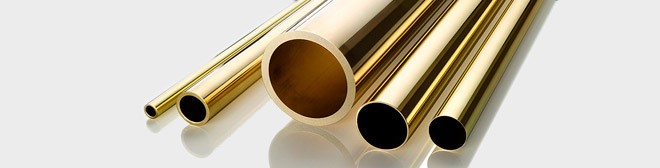
Admiralty Pipe:
This pipe is used in saltwater or freshwater environments and oil and petrochemical gas systems, where two features of corrosion resistance and high heat transfer rate are needed.
Brass collector:
Used in underfloor heating systems, collector connections, and water distribution systems in the engine room.
Standards:
Production of hollow sections, brass pipes and brass collectors is done based on the German DIN 17660 standard
Table of common dimensional specifications:
Thickness (mm) | External diameter(mm) | ||||
2 | 1.75 | 1.25 | 1 | 0.75 | |
|
|
| * | * | 16 |
|
|
| * | * | 18 |
|
|
| * | * | 20 |
|
| * | * | * | 22 |
|
|
| * | * | 24 |
* | * |
| * | * | 25 |
* | * |
| * | * | 28 |
|
|
| * | * | 30 |
* |
|
| * |
| 32 |
|
| * | * | * | 35 |
* |
|
| * | * | 38 |
|
|
| * | * | 40 |
|
|
| * | * | 45 |
| * | * | * |
| 50 |
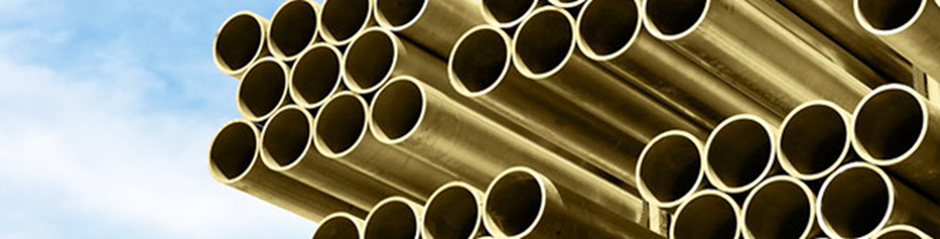
Chemical characteristics of bendable and hydro form lead-free pipes:
Name | Standard compliance | Chemical Compound | ||||||||
DIN | ASTM | Cu | Zn | Al | Fe | Ni | Pb | Sn | other | |
Common Brass | CuZn37 | C 27400 | 62-64 | rest | 0.03 | 0.1 | 0.3 | 0.1 | 0.1 | 0.1 |
Yellow Brass | CuZn36 | C 27000 | 63.5-65 | rest | 0.02 | 0.05 | 0.2 | 0.05 | 0.05 | 0.1 |
The application of this pipe is in construction valve industries, automobile radiator industries, building decoration industries and chandelier industries. Due to the fact that the alloy of this type of pipe is lead-free it has very good cold deformation characteristics and moderate machining.
Chemical characteristics of Admiralty brass pipes
Admiralty C 44300 alloy pipes:
Due to the alloy of the admiralty pipe, which has around one percentage of tin and a small amount of arsenic, this pipe has a high resistance to the corrosion of sea salt water and is used in making salt water condensers and tube oil heat exchangers.
This pipe can be used in salty or fresh water environments, as well as oil and petrochemical gas systems, where two characteristics of corrosion resistance and high heat transfer rate are needed.
Pipes and tubes for shell and tube heat exchanger:
This brass, which is also called sea brass or arsenic brass, has been used in heat exchangers and condensers due to its high resistance to corrosion and excellent heat transfer characteristics.
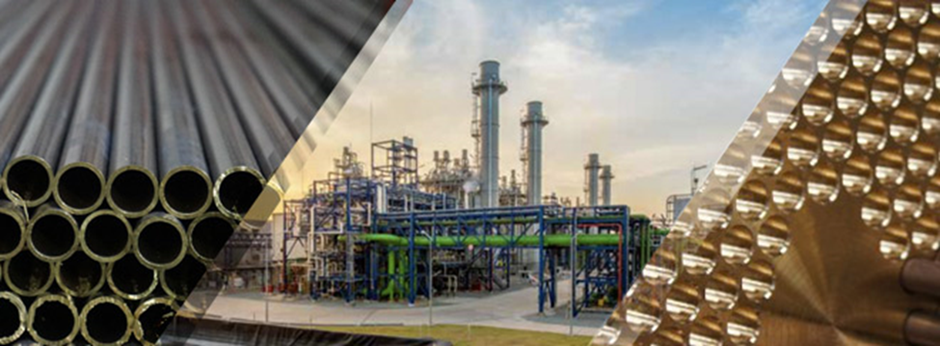
Chemical characteristics of Admiralty brass tubes:
Name | Standard Compliance | Chemical Compound | ||||||||
DIN | ASTM | Cu | Sn | AS | Zn |
|
|
|
| |
Admiralty brass | CuZn28Sn1 | C 44300 | 70-73 | 0.9-1.3 | 0.02-0.06 | rest |
|
|
|
|
|
|
|
|
|
|
|
|
|
|
|
Chemical characteristics of Aluminium brass tubes:
Name | Standard Compliance | Chemical Compound | ||||||||
DIN | ASTM | Cu | Al | AS | Zn |
|
|
|
| |
Aluminium brass | CuZn20Al2 | C68700 | 76-79 | 1.8-2.5 | 0.02-0.06 | rest |
|
|
|
|